The Research Regiment: Ukrainian and Russian Scholarship on Economic Security
By Nick Houttekier
24 August 2026
While Ukraine and Russia account for less than 2.5% of global academic output, scholars from both countries produced almost a quarter of all publications on economic security over the last two decades. The return of conflict in an ever more connected world has made the weaponization of economic interdependencies more frequent and consequential. In response, several states have introduced policies to protect the proper functioning of their economies. The security lens on economic policy is, however, still new and does not sit comfortably with many practitioners. The implementation of evidence-based economic security tools therefore requires additional research, analysis, and training. While the academic field is still emerging in most parts of the world, scholars from Ukraine and Russia have already studied economic security extensively. If we want to increase our own resilience, it might be worthwhile to consider their efforts.
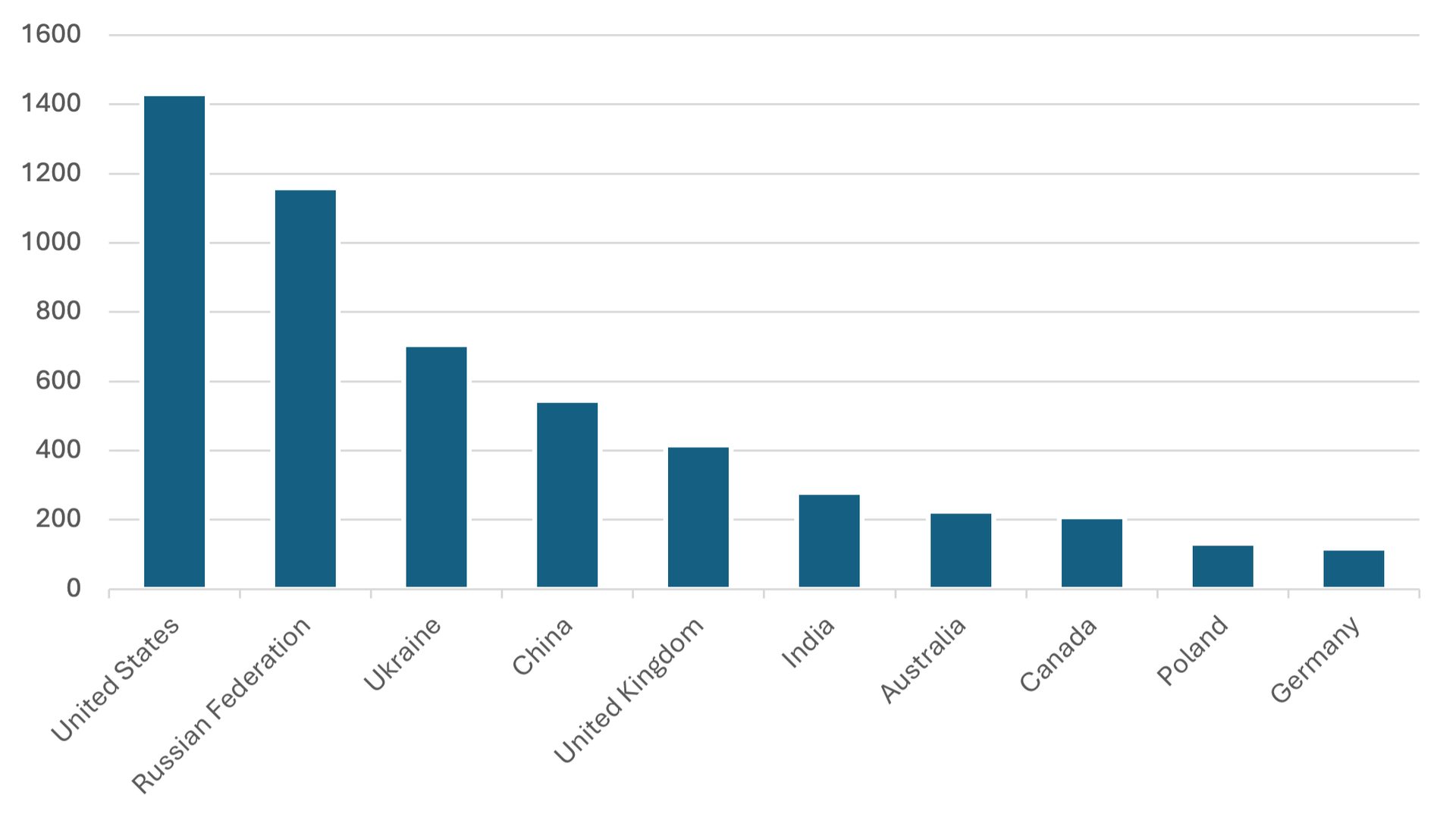
The clearest indication of Ukrainian and Russian prominence in the field of economic security is their publication output. Almost a quarter of academic texts on the topic includes at least one author affiliated with an institution of either country. Russian scholars authored or co-authored 14% of the publications. The country is second only to the United States, the world leader in almost every field, as Figure 1 demonstrates. Russian academics published more on economic security than scholars across the EU combined. Ukraine ranks third and ahead of the China and any EU member state, as it is involved in 9% of the publications. The results are impressive considering that Russia and Ukraine rank only 12th and 43rd worldwide in total academic output, accounting for merely 2.08% and 0.38% of publications across all scientific fields. While they are not academic powerhouses, they are among the top producers of economic security research.
Figure 1.
Top Ten Country Affiliations by Number of Academic Publications on Economic Security (2006-2019)
Source: Scopus (Global research database), retrieved 11 August 2026 from scopus.com
Note. The publications were selected if they contained ‘economic security’ in the title, abstract, or keywords.
Given their geoeconomic circumstances and recent history, the efforts of both countries to understand the economic security domain are unsurprising. Ukraine shifted its political and commercial focus in 2014, when it pivoted towards the European Union. In response, Russia annexed Crimea and launched military operations in the Donbas region. The EU responded by imposing economic sanctions on Russia. Consequently, the economic and security circumstances of both countries changed significantly. After Russia's full-scale invasion in February 2022, economic security came to play an even more important role. After the beginning of the invasion, Russia has become subject to no less than 21 far-reaching EU sanctions packages, while Ukraine has received extensive financial and material support from the EU. Because the invasion has by now turned into a protracted war of attrition, successfully maintaining a functioning economy will help determine the outcome of the conflict and the future of both countries. In the conduct of war, both countries also target each other's essential economic assets, such as oil refining facilities. It should therefore come as no surprise that economic security attracted considerable attention among their policymakers and academics.
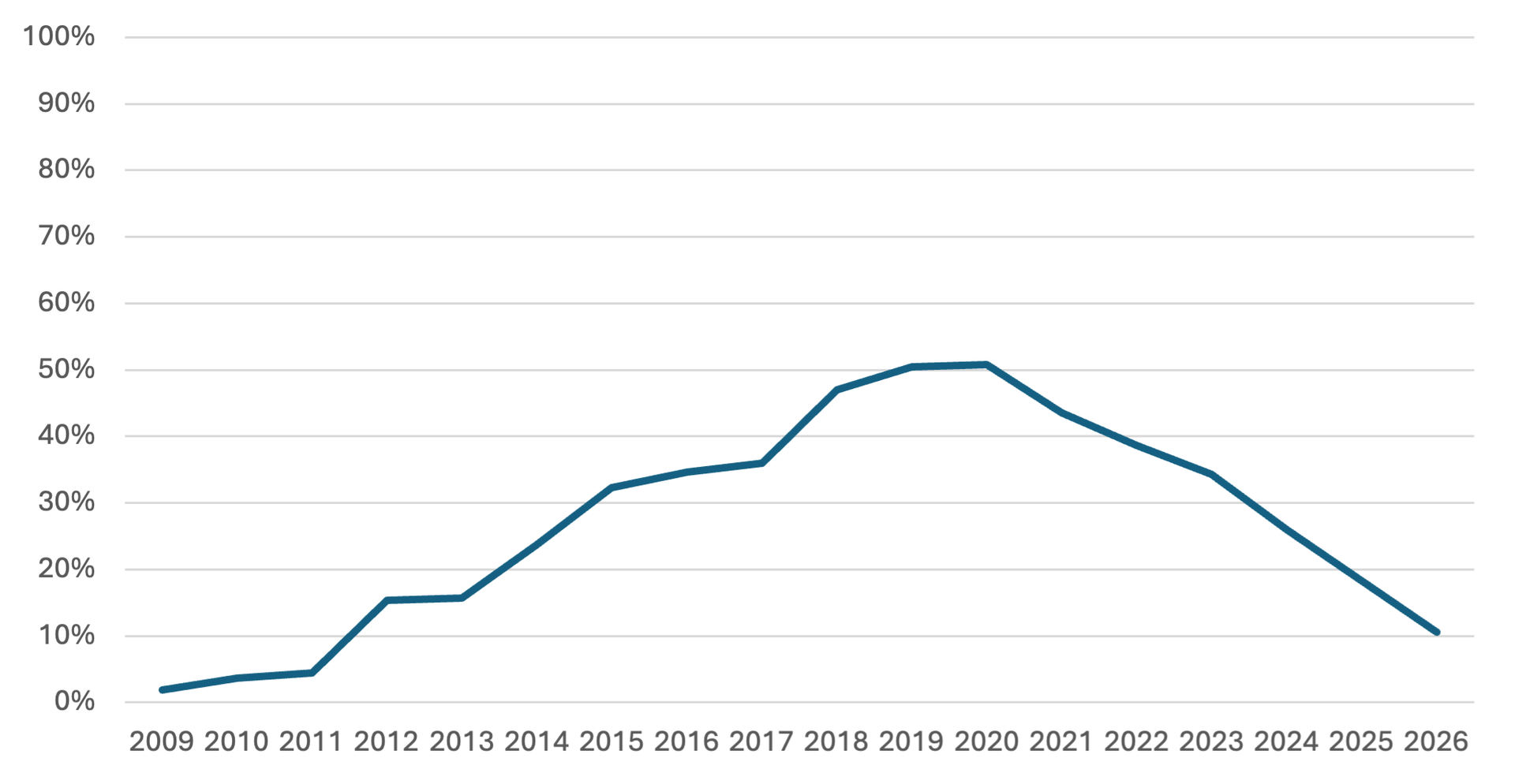
The publication trend suggests that scholars in both countries were responding to a growing awareness of the challenges ahead. The evolution of the output shown in Figure 2 indicates that both Russian and Ukrainian scholars were particularly productive in the years immediately preceding the full-scale invasion. The two countries’ combined publication output grew steadily from 2011 to 2017 before increasing rapidly between 2017 and 2021. Figure 3 shows that Ukrainian and Russian scholars authored more than half of all new publications in two consecutive years. Nevertheless, the number of new publications from both countries has declined since Russia’s full-scale invasion. The figures indicate that interest in economic security peaked in the period preceding the full-scale invasion. However, in 2025 (the last year with complete data), the two countries together were still involved of 18% of the output, well over their share of total academic publications.
Figure 2.
Evolution of the Number of New Publications on Economic Security
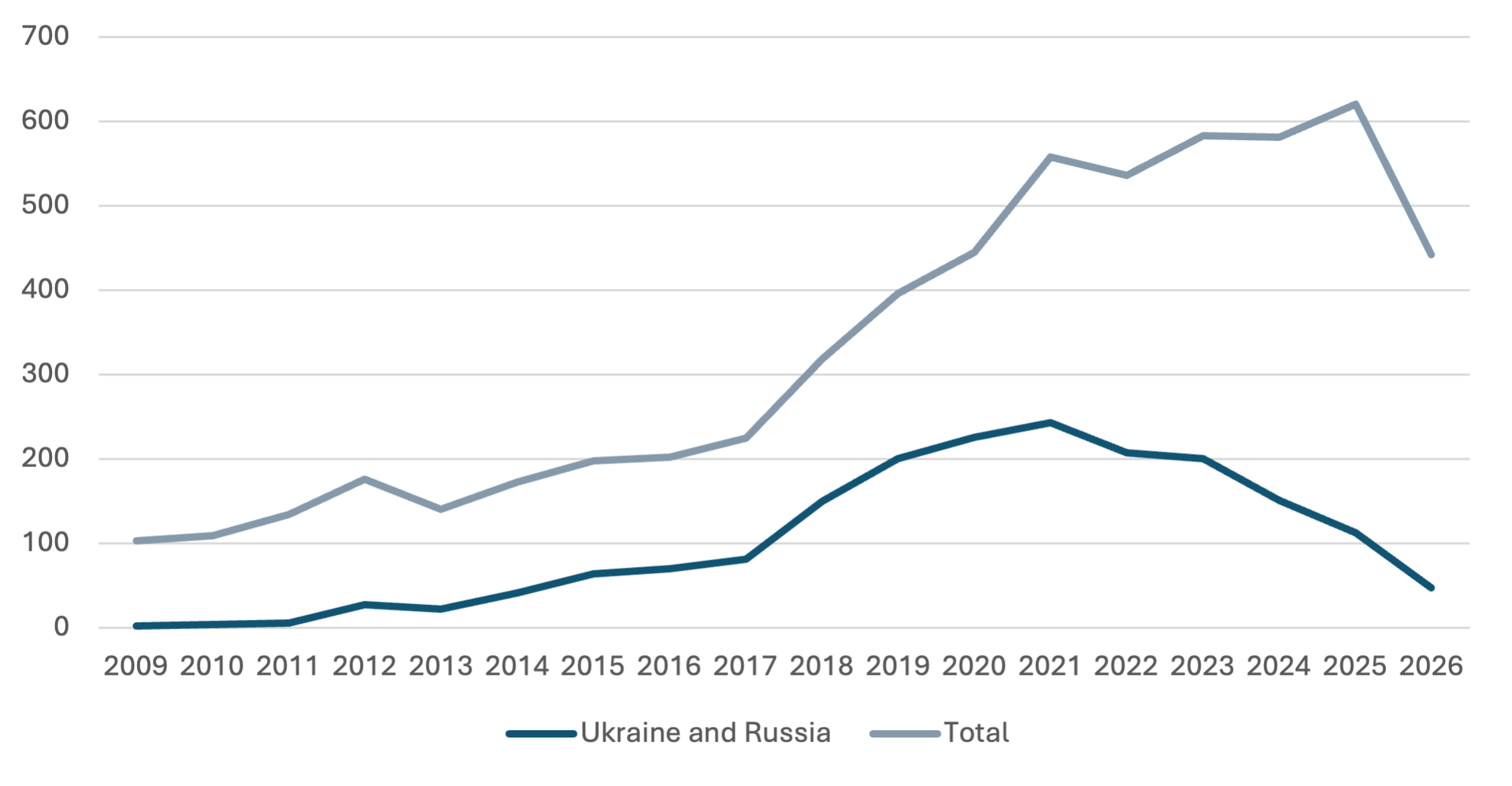
Figure 3.
Share of New Publications on Economic Security involving Ukrainian and Russian Scholars
Source: Scopus (Global research database), retrieved 11 August 2026 from scopus.com
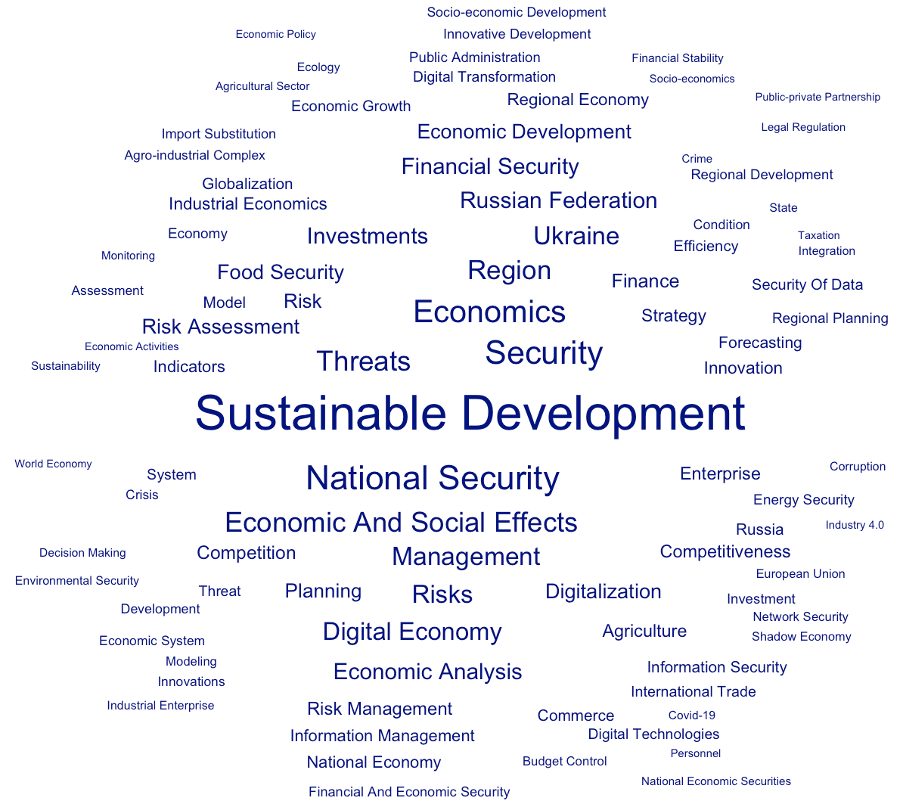
Even though all the publications address economic security, the specific focus of the texts varies and the concept itself should be interpreted in a broad sense. Many Ukrainian and Russian studies focus on the economic security of the state, but some of the publications focus on the economic security of specific sectors (such as the stability of the financial market) or private actors (such as the economic survival of agricultural wholesalers). Most of the studies, however, explicitly link national and private economic security. It is in the context of a broad interpretation of economic security that we should understand the prevalence of 'sustainable development' as the second most common keyword (after ‘economic security’ itself), as Figure 4 demonstrates. Several scholars argue that economic security is important for sustainable development and that sustainable development is important for economic security. A couple of studies explicitly discuss how the economic security of specific private actors is a prerequisite for sustainable economic development. Although not every study directly refers to geopolitics, they all address issues linked to the protection of economic activity, the strengthening of resilience, and the safeguarding of access to international markets.
Figure 4.
Word Cloud of the Most Common Keywords in Ukrainian and Russian Publications About Economic Security
Source: Scopus (Global research database), retrieved 11 August 2026 from scopus.com.
Note. The keyword ‘economic security’ was left out of the visualization
There are, however, important caveats to these observations. Russian and Ukrainian dominance in the field of economic security was temporary and the broad interpretation of the concept in their research does not always align with the geoeconomic meaning that economic security has acquired today. In addition, the sheer volume of publications does not necessarily correspond to quality, influence, or policy relevance. Finally, there are no policy documents that hint at a deliberate choice to focus on the topic. Although the Scopus database reveals that a lot of the publications were funded by government programs, it therefore remains unclear whether it was a deliberate strategy to push economic security as a research agenda.
Nevertheless, Ukrainian and Russian output on economic security remains impressive. It is difficult to believe that a large body of research emerging ahead of a period of profound economic disruption is entirely coincidental. When security experts look to both countries for policy lessons, they should therefore also examine the role of economic security scholarship.