Matrix of Geoeconomic Instruments
What is the matrix?
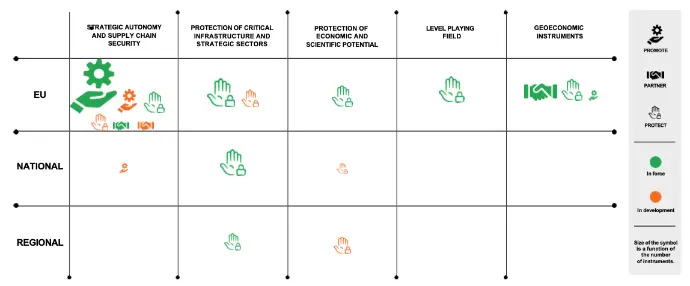
Changing times call for changing policy instruments. Since the EU made 'strategic autonomy' official policy in its 2016 Global Strategy, several instruments have been added to the geoeconomic toolbox. We have compiled an overview of the current and upcoming initiatives to keep track of the geoeconomic policy of the EU, the Belgian federal government and regional governments. In addition to the timeline, the Matrix also links the instruments with the EU Economic Security Strategy and the Belgian National Security Strategy. The Matrix will be updated regularly to reflect the creation of new policy instruments.
Click here to access the Matrix
Matrix update - 2025: a year of protection
At the end of 2025, we released an updated version of our Matrix of geoeconomic policy instruments. This update provides a reference point for tracking the evolution of these instruments by identifying those introduced over the past year and the strategic priorities they reveal.
What has changed in 2025?
While the initial edition of the Matrix showed a European Union primarily oriented toward the “promote” dimension, the new update highlights a marked strengthening of the “protect” side in 2025. Of the six new instruments identified, four fall mainly within a “protect” logic, while two are more closely associated with the “promote” category.
More specifically, the 2025 additions focus on four priorities:
- Strengthening material resilience and preparedness through the EU Stockpiling Strategy;
- Securing and structuring access to resources via the RESourceEU Action Plan;
- Enhancing the resilience of critical connectivity through the EU Action Plan on Cable Security;
- Regulating artificial intelligence (AI) with the AI Act.
On the “promote” side, two instruments complement this evolution: the AI Continent Action Plan and the Security Action for Europe (SAFE).
What priorities do these new instruments reflect?
Two main insights stand out.
First, the European geoeconomic agenda continues to be shaped by recent crises – the pandemic, the war in Ukraine, and geopolitical and trade tensions – though with a noticeable shift from reaction to preparedness. The EU Stockpiling Strategy is framed by the Commission as part of this shift within the broader Preparedness Union Strategy. Drawing on the lessons of COVID-19, it is designed to secure access to essential goods, organise stockpiling capacities, and make the Single Market more resilient to shocks.
In the same vein, the RESourceEU Action Plan is intended to support a strategy to reduce dependencies on critical raw materials. This effort is grounded in supplier diversification (avoiding excessive reliance on any single third country beyond a given threshold) and can also be read as a response to the risk of export weaponisation, notably by China.
This preparedness logic also extends to the protection of critical infrastructure. The EU Action Plan on Cable Security places the security of submarine cables at the heart of Europe’s resilience against hybrid threats and vulnerabilities in communications.
In a more directly security-related register, the Security Action for Europe (SAFE) is presented as a response to the deteriorating strategic environment in the context of Russia’s war of aggression against Ukraine. By making up to €150 billion in loans available to support investments and (often joint) procurement of defence capabilities, SAFE is meant to represent a step change in European preparedness, strengthen the EU’s industrial base, and enhance its capacity to support Ukraine over the long term.
Second, issues related to artificial intelligence (AI) are gaining prominence – both in terms of governance and regulation, and in terms of promotion and investment. On the one hand, the AI Act is intended to strengthen the EU’s ability to regulate AI-related risks and to set common rules. Although the regulation was adopted earlier, 2025 represents a key milestone with the entry into application of certain obligations, particularly those concerning practices deemed to pose an unacceptable risk. On the other hand, the AI Continent Action Plan seeks to accelerate AI deployment and investment to prevent a technology gap and support European competitiveness.
Why did we develop the matrix?
The goal of the Matrix is to help academics and policy makers keep track of the geoeconomic policy landscape in Belgium and the EU.
In the end of the 20th and the beginning of the 21st century there was general optimism about the peaceful effect of interconnected economic relations. Following the spirit at that time, the EU built its identity around open economic policy. However, during the last 10 years, the EU and its members states have taken protective measures as a response to a more hostile global conditions. Belgium accordingly included economic security in its first national security strategy.
The wide range of new policy initiatives makes it difficult to see which threats are being addressed and which still need more attention. The matrix helps to identify the domains which are being covered by existing and upcoming instruments and likewise helps to see the gaps.
What are some of the takeaways of the matrix?
The Matrix and the research leading up to the matrix have allowed us to make some analytic observations on the Belgian and European geoeconomic policy landscape. An elaborate explanation on these takeaways can be found in our accompanying policy paper.
Click here to access the policy paper
The key takeaways come down to the following points:
- The EU helps overcome fears of losing competitiveness, fears of retaliation, and domestic policy inertia
- The Belgian federal and regional governments mostly focus on the 'protect' dimension
- The EU mostly focuses on the 'promote' dimension
- Belgium is moving towards a more proactive and systemic risk assessment and management
How should you use the Matrix?
The Matrix consists of three parts: a visual representation of the policy instruments, a concise table with an overview of all the instruments, and a complete index of the instruments with a brief description. Readers that are interested in a quick overview can stick to the visual representation and those who are looking for more precise information can scroll down to the table or the index.
The visual representation is a cross-tab where the rows indicate the policy level and the columns indicate the categories of the Belgian National Security Strategy. The symbols identify the promote, protect or partner categories from the EU's Economic Security Strategy. Instruments in green are already in force, whereas those in orange are still under development.
How to cite
Compiling the Matrix of Geoeconomic Instruments was a joint effort of researchers of the Geoeconomics Group. We would therefore appreciate correct reference to the documents, the new information in the documents or the visual representations. We suggest the following reference (authors are in alphabetical order to represent the equal contributions to the final product):
Du Bois, C., Houttekier, N., Van Hoeymissen, S., Vigne, E. (2023). The Matrix of Geoeconomic Instruments. The Geoeconomics Group.